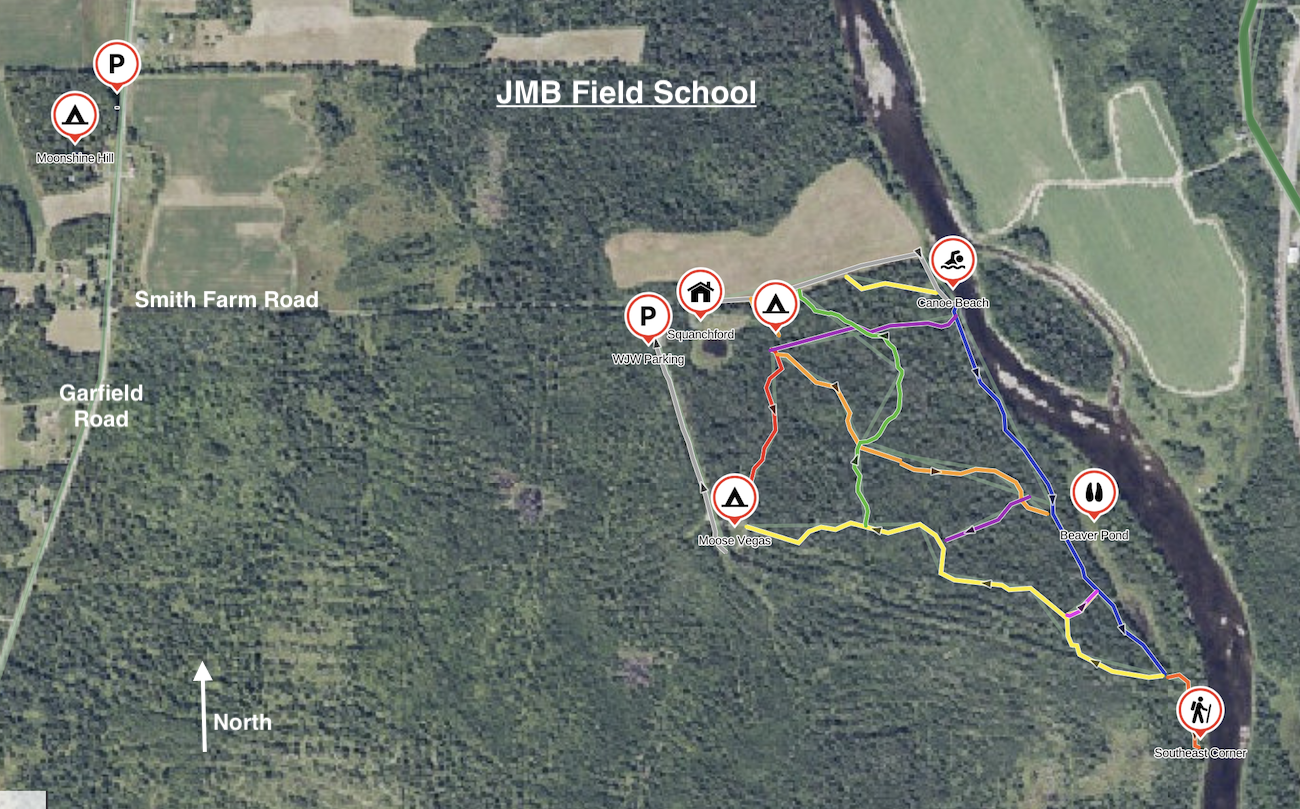
Our Bushcraft And Sustainability Field School is located on 83 acres in Masardis, Maine on the banks of the Aroostook River. We access different areas of the field school via the trail network, but concentrate the human camping to Moose Vegas and Hobo Junction during the warmer seasons, and Squanchford and Moonshine Hill during the snowy seasons.
Our camp is rustic. Drinking water comes from a hand pump and we’ve got no electricity other than what is generated on-site. It’s a perfect place for those seeking an authentic north woods experience.
Masardis is in Aroostook County, the northernmost county in Maine and larger than Connecticut and Rhode Island combined. Known as “The County”, it’s an area where the moose and black bears outnumber the people. Surrounded by Canada on three sides, it’s a boreal forest biome characterized by thick woods and northern plant species.
For more information on Masardis, read the info page from the Presque Isle Area Chamber of Commerce. The next town downstream is Ashland, Maine, known as the gateway to the North Maine Woods. Ashland is home to a diner and a grocery store. The nearest large town is Presque Isle, about a 35 minute drive, where there is lots of shopping as well as airline and bus service.
Directly across the Garfield road, the only paved road on our side of the river, is the North Maine Woods, a large (3.5 million acre), uninhabited working forest. It’s about 77 miles due west through working forest to the Canadian border and the town of Daquaam. In that space there is no pavement, no towns, and no permanent residents. For more information on the North Maine Woods, check out their website at northmainewoods.org. You can download a map of the region, either in full size (27×34, 7MB) or single sheet (8×10, 5.4MB) format from their map page.
Field School Geography
Squanchford & Hobo Junction
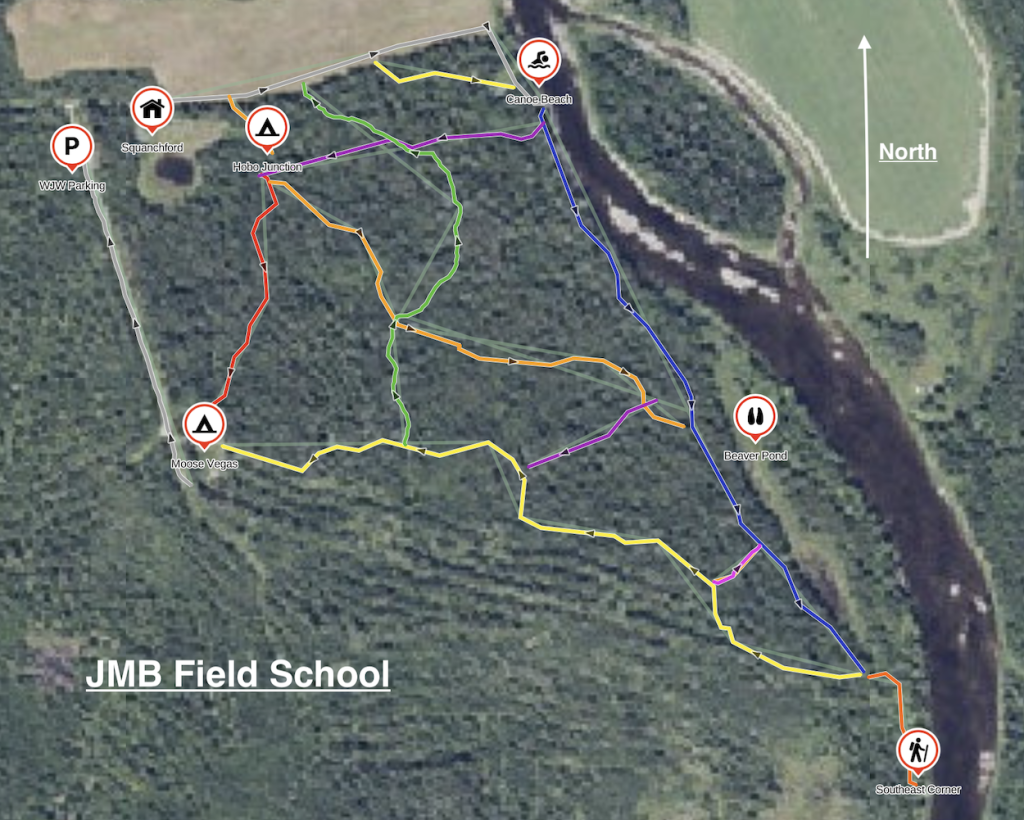
Squanchford is the central village of the field school, home to the Guide Shack, Pavilion, Boreas Cabin, Cook Shed, Grand Lac Samsquanch (the largest impoundment of the Samsquanch river), gardens, and the Quad. Named because of a shallow spot in the Samsquanch River where people used to cross before modern technology gave us the blimp. The Whiskey Jack Woods Parking Lot is on the edge of Squanchford. A short walk towards the river is Hobo Junction, a campsite and teaching area.
Moose Vegas
During residential programs students live in Moose Vegas. It is a high point on the property and the ground is dry. You can drive to Moose Vegas to pick up and drop off gear and supplies, but parking is a few hundred yards down the road at the Whiskey Jack Woods Parking Lot. Moose Vegas has a well, outdoor shower stall, humanure outhouses and a large field and outdoor cooking area.
Canoe Beach & Riverfront: 3000 Feet On The Aroostook River
This is where we swim, canoe, fish, and on-ramp to the highway that these northern rivers served as for thousands of years.
The Aroostook is the main artery of the area, and gives us water access to it’s headwater lakes, St. Croix Stream, the Blackwater River, the Big Machias River, Munsungan Stream, Millinocket Stream, Mooseleuk Stream and Squapan Lake and stream. The Aroostook crosses into New Brunswick and joins the St. John River, which empties into the Atlantic at St. John, New Brunswick.
We’re a short drive from the Allagash, St. John and Penobscot (East and West Branch) Rivers.
Moonshine Hill & The Athenaeum
Moonshine Hill is home to the Athenaeum, our headquarters, the Moonshine Hill teaching area and parking lot, and a seasonal campsite. It is one mile from Moose Vegas and 0.6 miles from the Guide Shack. The Athenaeum houses our resource library, digital archives, and map collection.
Field School Systems
Camping
During our spring, summer and fall courses students stay their own tent. They also build a variety of different shelters and stay in them for several days, or for the duration of their stay if they choose. You will not be carrying your tent any distance, so plan to get one that’s comfortable even if it’s heavy and bulky. During the winter program, students stay in woodstove-heated shelters while at our home base, and in woodstove-heated wall tents in the bush.
Bringing or buying an extra tarp to keep your gear dry, both at the field school and on trips, is a great plan. We have no inside storage.
In extended periods of wet weather, your tent should be large enough so that your sleeping bag doesn’t touch the tent wall. If it touches, it gets wet, regardless of how much you spent on your tent. If you’re taller than 5’6″, consider getting a 4-person tent to use solo. 2-person tents often don’t work that well for tall people.
Bathing and Hygiene
Everyone is expected to maintain an acceptable level of hygiene during the course. This is accomplished by swimming in the river (without soap or shampoo), bucket baths (with soap and shampoo) and showers of some sort.
This video was shot on May 7th, 2018. They don’t sell these pump up solar showers anymore, but now there are lots of good options on the market.
I’ve used this one for over a decade. Fill it, let it sit in the sun, and shower at the end of the day. I’ll often pour off a gallon or so into a pot and boil it, then pour it back in for a hot shower. There is a page on BushcraftSchool dot com’s gear forum with the names of the parts with links.
Regardless of what it says on the label, absolutely no soap, even if it is “biodegradable” or camping soap, is to be used within 250 feet of the river, pond, or stream, or any other natural source of water.
If you’d like to have your own personal hot shower whenever you want it, consider bringing a sunshower. (There are numerous models running from $10-$40.) Fill it in the morning and by afternoon you’ll have 5 gallons of hot water to use in our shower enclosure. The downside to these is that they don’t last all that long, have to be hung from above, and end up in a landfill. The upside is that they are pretty cheap and get the water hot on a sunny day.
There are also modern, indoor showers available nearby. For a list of where, visit our Travel & Local Information page.
Composting System And Dry Toilets
Before their course begins, each student is encouraged to read a Compost Toilet System Condensed Instruction Manual. This is the condensed version of the work of Joseph Jenkins from his two books The Compost Toilet Handbook and The Humanure Handbook, both of which are highly recommended. (Read more here)
The condensed instruction manual introduces the composting toilet system we use, and will answer any questions the student might have about procedures, pathogens and safety. We’ve been using this system since 1996, and have experienced no problems with it. It’s simple, odorless, uses minimal inputs and is the basis of our thermophyllic composting system. Keep in mind that we don’t have an alternative to the humanure system. If using a composting toilet makes you significantly uncomfortable, then field school programs are probably not a good option for you.
We have five outhouses at the field school. If you want to upgrade your personal accommodations to include your own private toilet for your tent or shelter, consider bringing your own toilet seat and 5 gallon bucket (or 2 buckets). These Luggable Loo toilet seats clip onto a bucket. You can also improvise your own seat or build a toilet box like the ones we use based on the instructions in the Humanure Handbook. Other options include making one of these milk crate toilet boxes or buying one of these plywood toilet boxes.
This scalability is one of the benefits of the humanure system. With a conventional toilet system, the collection locations (ie. toilets) are centralized because they have to be connected to pipes. With the more advanced humanure system, the collection locations can be decentralized, with the processing facility (ie. compost pile) being centralized.
An important underlying principle of this system is that what comes out of our bodies, when properly processed, is a resource and not a waste product. This system, when managed properly, is inexpensive, hygenic, and simple to maintain in an on or off grid location. When poorly maintained, it can quickly become a disgusting disease vector. We will be managing it properly. Those who can’t get on board with this system after a few days will be asked to leave as we don’t have an alternative system.
Trash & Recycling
We keep a clean camp in order to avoid habituating animals to human food and trash. In a nutshell with our system, if the trash is burnable (paper, cardboard, etc.) we burn it. If it is plastic or something else that should’t be burned, we trash it. And if it can be recycled, we recycle it. Note that Maine has a bottle bill, which means when you get a can of soda, for example, you pay an extra five cents per can. We collect these and turn them in to get the five cents per container back.
A few years ago we had a raccoon who kept tipping over trash cans at night and making a mess. Since then, we no longer use regular trash cans. All trash is now kept in 5-gallon buckets with screw-on lids. We have found that 8-gallon trash bags fit these perfectly. When the bags are full we take them to the Athenaeum until we can take them to the dump.
There is an old saying that a fed bear is a dead bear. Once animals get habituated to human food, they will not stop going after it. So, we keep a clean camp with food kept in hard-sided containers that squirrels can’t bite through. People who cannot get on board with this system, or have to be constantly reminded to clean up, will be asked to leave.
It is a stated goal of ours to minimize the trash we need to haul away. For more on this, take a look at books/articles on living a zero waste lifestyle.
Charging Batteries, Electricity
Our field school is off the grid. We have a small solar system for our needs, but it is NOT available for students to charge their cell phones, etc. We have several charging stations available for student use. These are 100 watt solar panels that output to USB. We recommend students charge batteries with these, then use the batteries to charge their electronic devices. We were advised by an engineer to not charge electronic devices directly with this system. If you are a heavy device user, please consider getting your own portable solar power system. Keeping your devices charged is your business, not ours.
If you’re planning on driving to the field school, plan ahead and get an inverter for your vehicle. These plug into the cigarette lighter and outputs through a standard AC plug. Part of living off the grid is that whenever your vehicle is running, you’re charging something. If you’re vehicle is running and you’re not also charging something, you’re wasting energy.
Laundry
You should read this blog post titled Why Doing Laundry By Hand Matters, And A Laundry Soap Recipe. There are some very dated laundry machines behind the One Stop in Ashland, and a modern laundromat in Presque Isle.
Phone
We are completely off the grid and don’t have a landline phone. Past students who wanted to be in constant telephone contact have used cell phones to do so. We get good cell phone reception at the field school, as there is a cell tower several miles away (currently leased by Verizon). If you want to stay in touch but don’t have a cell phone, consider a prepaid cell phone. Past students have used TracFones and had good reception. Both Verizon and AT&T phones work well (5 bars), as does Straight Talk. One past student from Europe brought a T-Mobile phone and it didn’t work at all. Sprint phones have also not worked in the past.
Internet
We have wifi in the Athenaeum. It works great for our purposes, but if you’re the type of person who likes to download whole seasons of TV shows, it is very slow – often slower than the cell tower signal. A few years ago it took a guy over an hour to download a season of a show he liked. Then he went to the Ashland library and it only took 3 minutes.
On the days that it is open, the Ashland Community Library has wifi. Even if it is not open, you can pick up the wifi in the parking lot.
The Turner Memorial Public Library in Presque Isle has an open wifi connection. There are several other spots in Presque Isle that have wifi, including Tim Hortons and McDonalds.
Cars And Parking
At the field school parking is only allowed in the Whiskey Jack Woods parking lot and the Moonshine Hill parking lot. While we do allow people to pick up and drop off items in the turnaround in Moose Vegas and at the Quad in Squanchford, no vehicles are to be left here for longer than it takes to load and unload.
If you will be coming to the field school without your own means of transportation, you should be aware that the field school is in a very small town in rural northern Maine. There are no stores within walking distance, with the closest being 7-8 miles away. On past courses we have organized a weekly trip into Ashland to go to the Ashland Foodmart (grocery store) and the Ashland farm stand, for students without their own means of transportation.
If you are going this route, you should consider having groceries and other items delivered to you at the field school, especially for any specialty items. It would benefit you to have this process figured out before you arrive.
We encourage students to carpool and share rides into town.
Bicycles
It is exactly one mile from Moonshine Hill to Moose Vegas. It is about 6/10s of a mile from Moonshine Hill to Squanchford. It is 600 yards from Squanchford to Moose Vegas and on any given day we are back and forth between them several times. Many past students have brought bicycles to speed up this commute. This is a great idea, although not mandatory. Here’s what the ride from Moonshine Hill down to Squanchford looks like: